

Manu, weaving her family's future along with Dhaka clothes on the handloom
After her studies were halted due to financial hardship, Manu from Bhakkili, Beni Municipality–3, Myagdi, has been running her household and covering the educational expenses of her two brothers and one sister by weaving Dhaka products on a handloom.
August 11, 2026 by Prakash Baral (Ekantipur.com)
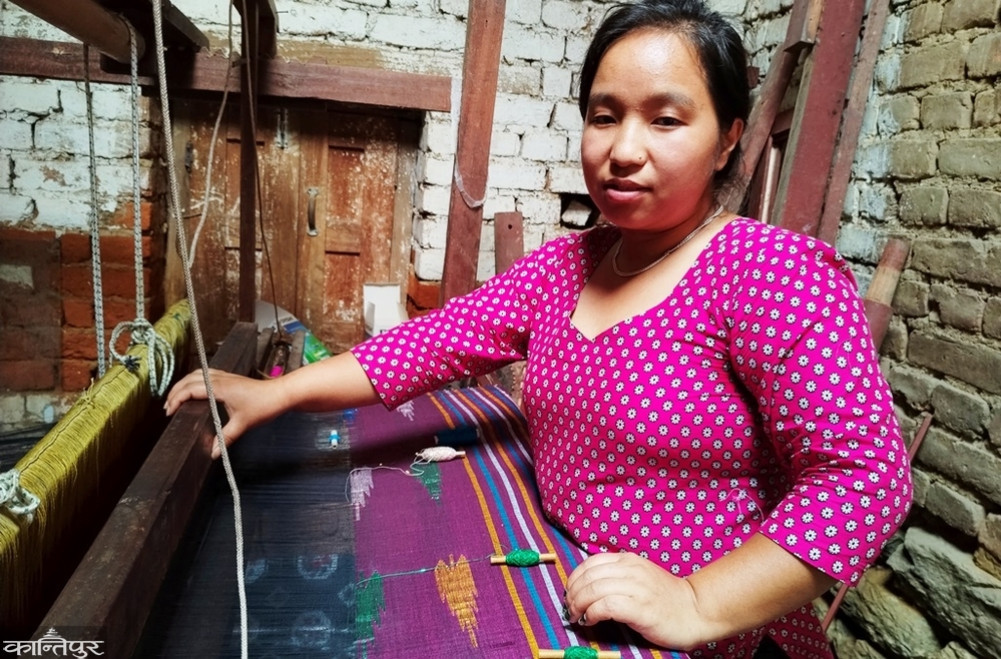
In a small room of an old house at Laligurans Chowk in Baglung Bazaar, fingers weave Dhaka fabric all day long on a handloom. Even when her hands and feet are tired, her determination does not give in to fatigue. This loom has not only woven Dhaka fabric, but is also weaving the dreams and future of an entire family.
She did not even have the money to buy that machine. The handloom given by a neighbor, Sanima, as a gesture of support, has become a lifeline for shaping her future. Along with her parents’ dreams, the future of two brothers and a sister is also being woven there.
Although Manu Pun’s home is in Bhamkili, Beni Municipality–3, Myagdi, she has been found weaving dreams like this in Baglung Bazaar for the past 12 years. After passing SLC, she came to the bazaar with the aim of pursuing higher education, but her studies were interrupted midway due to financial constraints. She could not study herself, but the desire to make her siblings’ future beautiful was awakened in her. She resolved to educate her brothers and sister at any cost. For that, she wanted to start a business. She had no money to invest. No one trusted her enough to lend her money. She relied on her maternal aunt’s support.
She said that she was able to weave her siblings’ dreams on the wooden machine given by her aunt. “I am earning by working 12 to 15 hours daily on the wooden machine she gave me,” she said, “I couldn’t study due to lack of money, but I will fulfill my dream of educating my siblings at any cost.” She bears the responsibility of caring for her entire family. That responsibility weighs so heavily on her that she cannot rise above it. She said that no matter how much she earns, it is difficult to save.
Her father Karn Bahadur and mother Mila are ordinary farmers. They keep cows and buffaloes and live in the village. She has been the one to educate her sister Bhawana and two brothers by keeping them in Baglung Bazaar. Now, her sister has passed grade 12. The two brothers are studying in grade 11. Since the family could not afford enough to eat, her parents could not educate them, so Manu took that responsibility on her own shoulders. Her elder sister is already married. The household runs on the earnings of Manu, the middle daughter.
She is now 29 years old. Many of her friends have married and are raising children. But Manu says she does not have the freedom to marry yet, even if she wants to. With the dreams of her entire family resting on her shoulders, she has not even been able to consider marriage. The machine she starts at 7 in the morning runs until 10 at night. The monthly rent for the room where the machine is kept is 8,000 rupees. The room she lives in costs 5,000. Including food, accommodation, and her siblings’ education expenses, she spends 30,000 rupees a month. Her parents come to the bazaar from time to time when they fall ill. She has to pay for their medical treatment. Besides that, Manu is also the one who sends money home for household expenses.
Even after managing all this, she continues to work hard. Manu said she works with the goal of earning 40,000 to 50,000 rupees a month. “If I don’t work, my family will go hungry, and my siblings’ studies will suffer,” she said. “I don’t have the option to go elsewhere without achieving my goal.” She said that neighbors often urge her to go abroad or get married. But she has no desire to go abroad. Instead, she is determined to send her products overseas.
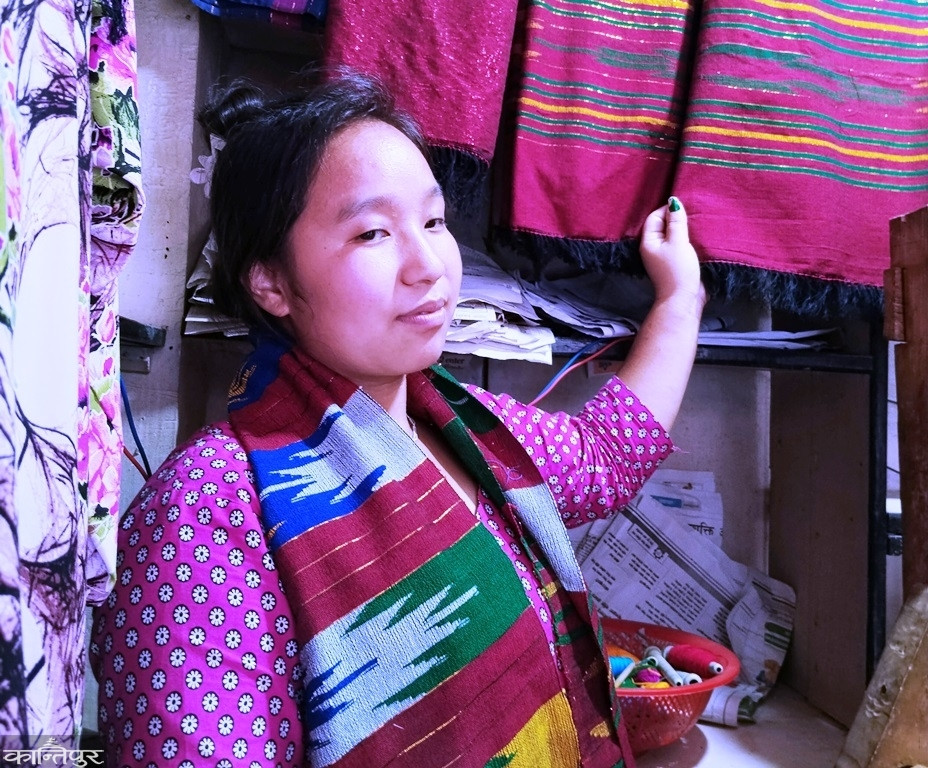
For the upcoming Teej festival, three people living in America have ordered Dhaka saris. There have also been orders for four saris—two each from Badigad Rural Municipality in Baglung and Chandrakot in Gulmi. She will have to prepare those saris within a month.
To make one Dhaka sari, she has to sit at the loom and work diligently for four to five days. “If I can’t deliver the sari on time, people will lose trust in my business,” she said. “If I can maintain that trust, regular orders will keep coming.” Because of the need to fulfill orders, even when she is sick, Manu is found working at the loom after taking medicine. Orders are also coming in from abroad for Dashain and Tihar. A plain Dhaka sari can be sold for 9,000 rupees. If it is intricately patterned, it can cost between 15,000 and 20,000 rupees. About one-third of the investment goes into thread. She said she sets the price by adding up her hard work.
Recently, Nepalis living abroad have started ordering Dhaka saris. In the beginning, she worked by finding customers locally, but now orders have started coming in. She also promotes her products by posting them on social media. She works according to the orders she receives. “During my free time, I make some saris, shawls, bags, caps, and scarves and keep them ready,” she said. “When there are orders, I have to finish their work first.” Her sister Bhawana, who is still studying, has also learned the craft and started adding patterns to shawls. Manu said she feels some relief as her sister’s skills improve.
She has worked very hard to reach this profession. When she visited her maternal home in Dhamja, Kathekhola Rural Municipality–3, and saw small entrepreneurs weaving Dhaka and Allo, she wanted to become an entrepreneur herself. To learn the skill, she applied to the then Industry Office in Baglung, but was denied training because she was from another district. That made her even more anxious. After learning the skill for some time at her aunt’s house, she became able to work on her own.
